Table of Contents
Introduction
When you step into a gym or browse fitness writings, you’ll often hear trainers talking about “compound” and “isolation” exercises. Whether you are just starting the fitness journey or have been training for a while, these terms can feel like technical jargon. Nevertheless, understanding the difference between them is the “secret sauce” to building an effective workout routine.
Whether your goal is to lose weight or fat, build muscle, or move better in daily life, knowing when to use a compound movement and when to choose an isolation exercise will change how you approach training.
In this, we will break down both types of movements, look at their pros and cons, and help you decide how to balance them for the best results.
In the world of fitness, there is a continuous debate: Should you focus on heavy whole-body lifting or target specific muscles to “sculpt” the physique? The truth is, the most successful athletes & fitness enthusiasts don’t choose one over the other; they master both.
Comprehending the mechanics of compound and isolation movements is the foundation of a professional-grade workout routine. Whether you are writing your first fitness plan or looking to break through a plateau, these 8 master moves will provide the blueprint for total-body transformation.
1. What are compound movements?
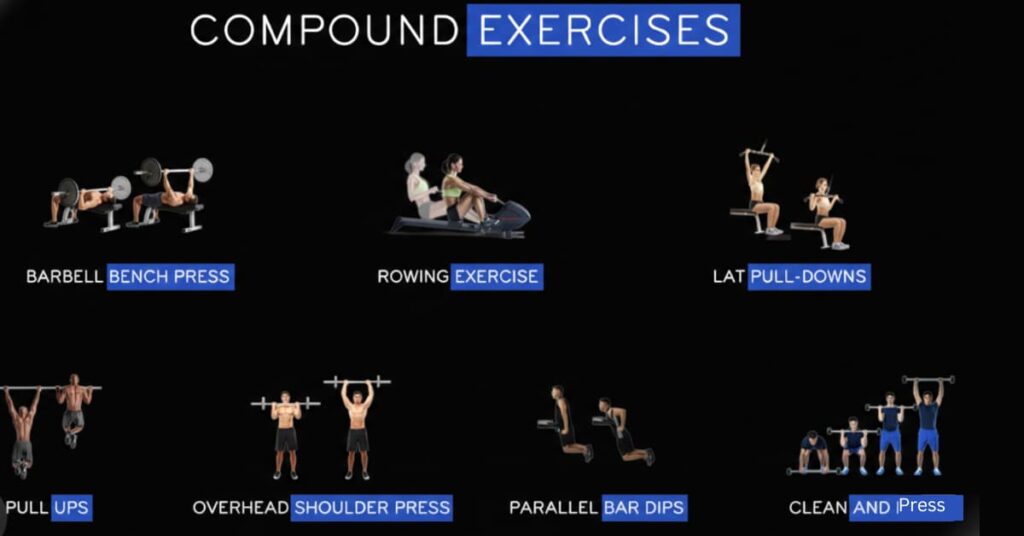
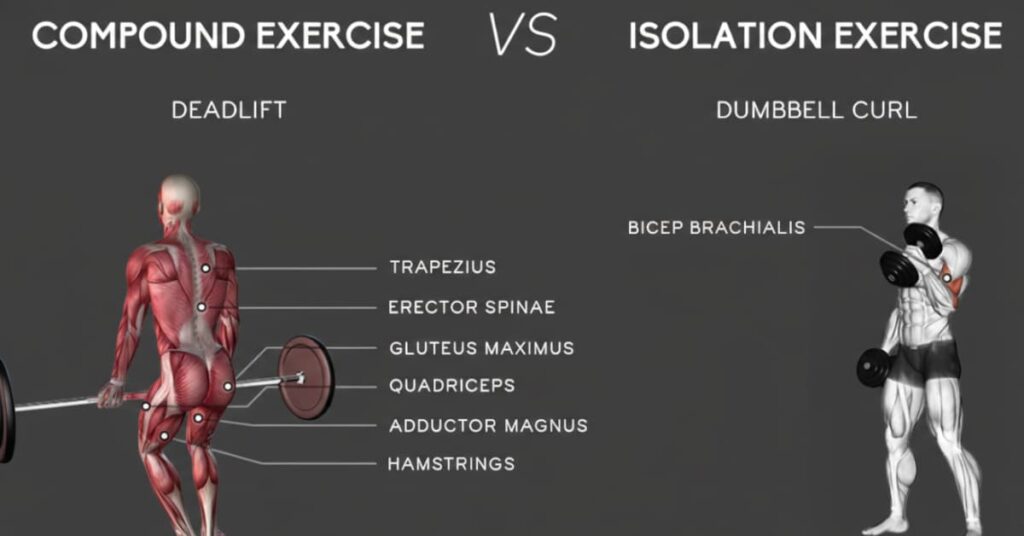
A compound move is a multi-joint exercise that works several muscle groups simultaneously. Think of these as “big” movements. Because you are using more than one joint (for instance, the knees and the hips), you are naturally engaging a bigger amount of muscle mass.
How They Work
When you conduct a compound lift, the body acts as a single unit. There is usually a “primary mover” (the main muscle doing the work) and “secondary movers” (muscles that assist).
Popular Examples of Compound Movements:
- Squats: These involve the hip and knee joints and work the quadriceps, hamstrings, glutes, & core.
- Deadlifts: One of the most influential full-body moves, engaging the entire “posterior chain” (back, glutes, and hamstrings).
- Push-ups / Bench Press: These use the shoulder & elbow joints to work the chest, shoulders, and triceps.
- Pull-ups / Rows: These engage the back and biceps by driving the elbows and shoulders.
2. The Benefits of Compound Movements
If you are short on time but want maximum results, compound actions are your best friend. Here’s why:
A. Maximum Calorie Burn
Because compound movements use more muscles, they need more energy (calories) to perform. If weight loss is the goal, movements like squats and thrusters will get the heart rate up much faster than a bicep curl.
B. Efficiency
Why spend two hours at the gym when you can get a full-body workout in 45 minutes? By hitting multiple muscles at once, you can lower the total number of exercises needed in the session.
C. Functional Strength
In real life, we rarely move just one joint. When you pick up a heavy box from the floor, you are practically doing a deadlift. Compound movements mimic real-world activities, making you stronger for daily life and lowering the risk of injury.
D. Hormone Production
Heavy compound lifting has been shown to stimulate greater release of growth hormone and testosterone than isolation moves. These hormones are very vital for muscle repair and fat loss.
3. What are isolation movements?
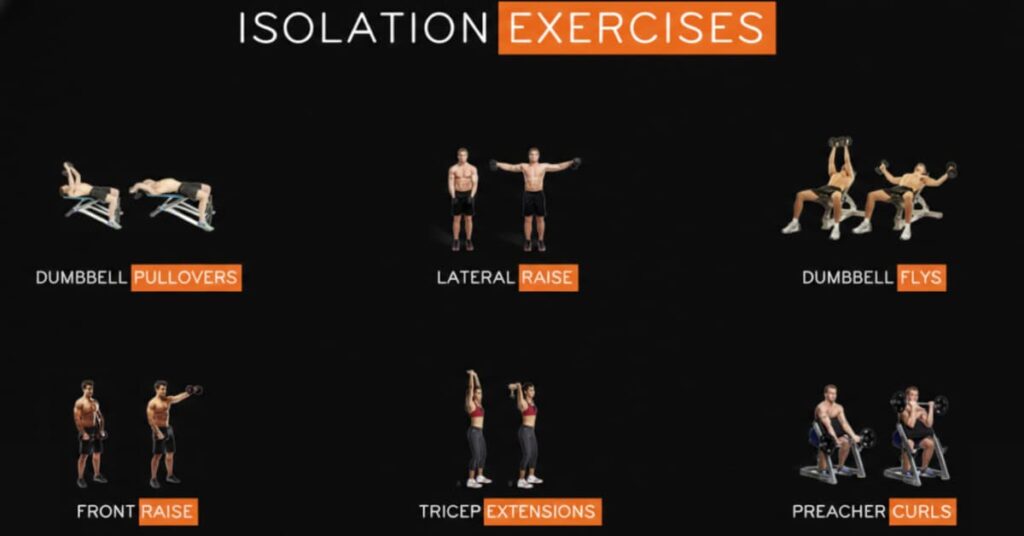
An isolation movement is a single-joint exercise that targets one specific muscle group. As the title suggests, the goal is to “isolate” a muscle so it can do all the work without help from its neighbors.
How They Work
During an isolation movement, only one joint moves. It allows you to focus entirely on the “pump” or the contraction of a specific muscle.
Popular Examples of Isolation Movements:
- Bicep Curls: Only the elbow joint moves, concentrating purely on the bicep.
- Leg Extensions: Only knee moves, targeting the quadriceps.
- Lateral Raises: Only shoulder joint moves, concentrating on the side of the shoulder (deltoids).
- Calf Raises: Only ankle moves, targeting the calf muscles.
4. The Benefits of Isolation Movements
While they might not burn as many calories as a squat, isolation moves are important for a well-rounded physique.
A. Correcting Imbalances
We all have one side that is stronger than the other. In a compound move like a bench press, the stronger side might take over. Isolation movements (such as a single-arm dumbbell press) ensure each muscle carries its own weight.
B. Rehabilitation and Injury Prevention
If you are recovering from an injury, compound movements might be too taxing. Isolation workouts allow you to strengthen a specific area (like the rotator cuff or the vastus medialis in the knee) without overstressing the rest of the body.
C. Aesthetic Shaping
Bodybuilders love isolation activities because they allow for “fine-tuning.” If you feel your shoulders lack width or the triceps aren’t “popping,” isolation activities let you give those areas extra attention.
D. The Mind-Muscle Connection
Because you aren’t worried about balancing a heavy bar or coordinating multiple joints, you can really focus on “feeling” the muscle work. Mental focus is key to muscle hypertrophy (growth).
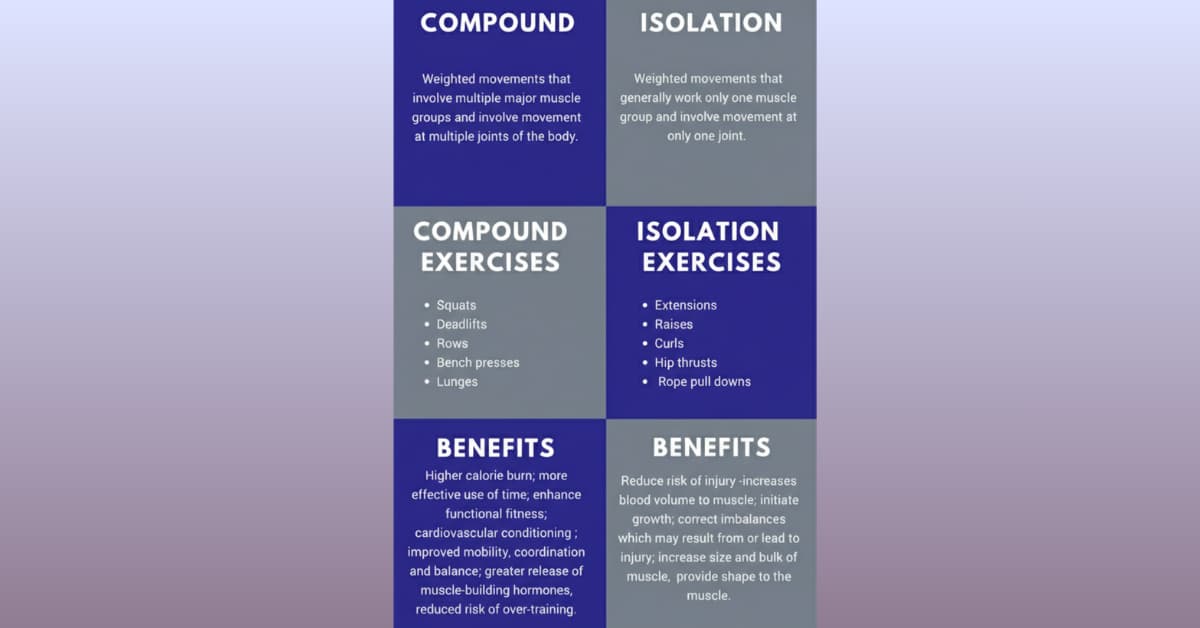
5. Compound vs. Isolation: A Side-by-Side Comparison
To make it easy to comprehend, let’s look at how they stack up against each other:
| Feature | Compound Movements | Isolation Movements |
| Joints Involved | Multiple (2+) | Single (1) |
| Muscles Targeted | Many at once | One specific muscle |
| Weight lifting or weight training | Heavy | Light to Moderate |
| Calorie Burn | High | Low |
| Goal | Strength, Power, Weight Loss | Muscle Detail, Rehab, Balance |
| Example | Barbell Row | Bicep Curl |
6. How to Structure Your Workout
The most typical question is: “Which one should I do first?”
The general rule of thumb in the wellness world is Compound First, Isolation Last.
The Energy Logic
Compound movements need the most energy, focus, and coordination. Do your squats or overhead presses at the beginning of the workout when you are fresh. If you tire out the triceps with isolation work first, you won’t be able to bench press as much weight safely later.
The “Finisher” Concept
Think of isolation moves as the “dessert” or the “finisher.” Once you’ve done the heavy lifting, use isolation exercises to fatigue the muscle and achieve good blood flow (the pump) to the area.
7. Real-World Examples: Sample Workout Routines
Let’s see how a proportional “Leg Day” and “Push Day” would look, utilizing both movement types.
Sample Leg Day Workout:
- Back Squats (Compound): 3 sets of 9 reps (Focus on power).
- Romanian Deadlifts (Compound): 3 sets of 12 reps (Focus on hamstrings/glutes).
- Leg Press (Compound): 3 sets of 10 reps (High volume).
- Leg Extensions (Isolation): 3 sets of 15 reps (Targeting the quads).
- Seated Calf Raises (Isolation): 3 sets of 20 reps (Targeting the calves).
Sample Push Day (Chest/Shoulders/Triceps):
- Overhead Press (Compound): 3 sets of 9 reps.
- Incline Dumbbell Press (Compound): 3 sets of 12 reps.
- Lateral Raises (Isolation): 3 sets of 15 reps (Shoulder shape).
- Tricep Pushdowns (Isolation): 3 sets of 12 reps (Tricep focus).
8. Common Mistakes to Avoid
1. Ignoring Compound Lifts Because They Are “Hard.”
It is tempting to do machines and isolation moves because they are easier to learn. Nevertheless, you will plateau quickly if you don’t include big lifts. Don’t be afraid of the squat rack!
2. Overdoing the Weight on Isolation Moves
The goal of an isolation movement is not to lift the heaviest weight possible; it’s to feel the muscle. If you are swinging the body to do a bicep curl, you are turning it into a bad compound movement. Keep the form strict.
3. Neglecting Recovery
Since compound exercises stress the central nervous system (CNS) more than isolation moves, you need adequate rest. Don’t try to do max-effort deadlifts every single day.
Conclusion
In the debate between compound and isolation, there is no “winner”; only the best tool for the job.
If you want to get powerful, lose fat efficiently, and improve your athleticism, compound movements should be the foundation of your program. If you want to refine the physique, fix muscle imbalances, or safely rehab an injury, isolation movements are the tools you use to decorate and maintain that house.
A perfect workout plan uses both. Begin big, finish small, & always prioritize form over the weight on the bar.
Mastering the body requires a strategic approach. You cannot build a house without a strong foundation (Compound Moves), but you also wouldn’t want a house without windows and doors (Isolation Moves).
By prioritizing the 8 Master Moves outlined in this guide, you ensure the training is efficient, safe, and balanced. Start the sessions with power, finish them with precision, and watch your body respond.
The most important thing to remember is consistency. Whether you are squatting 100kg or doing bicep curls with 5kg, showing up and moving with intent is what creates the “Relite” version of your health.