Table of Contents
Introduction
Every movement the body performs, from a subtle blink to a heavy deadlift, is the result of a highly coordinated “team effort” between four distinct muscle roles: the agonist, antagonist, synergist, and fixator. Instead of muscles working in isolation, they operate in functional groups, that is, muscle roles where the agonist (the prime mover) generates the main force.
At the same time, the antagonist provides the necessary “brake” by lengthening to control the motion and protect the joint. Supporting this duo are the synergists, that assist the prime mover to add power & precision, and the fixators, which act as stabilizers to “lock” nearby joints in place, providing a sturdy foundation for the movement to occur. Comprehending this dynamic interplay is essential for anyone looking to improve or enhance their physical performance, prevent chronic muscle imbalances, or appreciate the complex biological engineering that allows the human body to move with fluid grace and stability.
To truly understand fitness, physical therapy, or even just basic human movement, you need to meet the four “players” in every movement ( muscle roles): the Agonist, the Antagonist, the Synergist, and the Fixator.
1. The Agonist muscle roles: The “Prime Mover.”
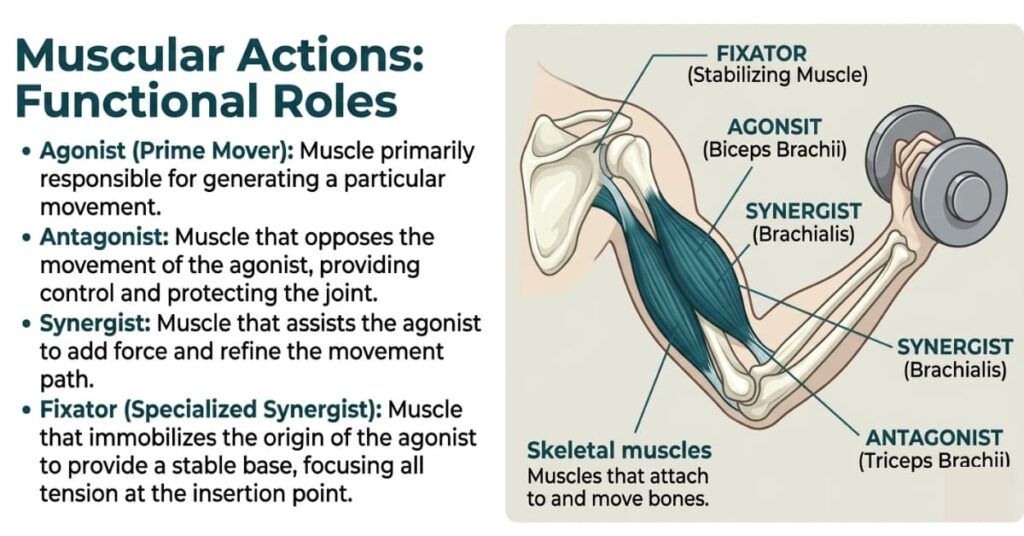
The agonist (muscle roles) is the chief of the pack. When you decide to move a limb, the agonist is the muscle primarily responsible for generating that specific movement. It’s the muscle that is actively contracting (shortening) to pull on the bone.
How it Works
Think of the agonist muscle roles as the engine of a car. It delivers the horsepower needed to get things going. Because it does the bulk of the work, it’s often the muscle you’re trying to target during a specific exercise in the gym.
Examples in Action
- The Biceps Curl: When you lift a weight toward the shoulder, the Biceps Brachii is the agonist. It contracts to flex the elbow.
- The Leg Extension: When you straighten the leg at the knee, the Quadriceps act as the agonist.
- Push-ups: When you push yourself up away from the floor, the Pectoralis Major (chest muscle) is the agonist.
2. The Antagonist muscle roles: The “Regulator.”
If the agonist muscle roles is the gas pedal, the antagonist is the brake. The antagonist is the muscle that opposes the agonist muscle roles. While the agonist contracts, the antagonist is typically stretched.
Why Do We Need an “Opponent”?
You might wonder why we have muscles that oppose each other. Isn’t that counterproductive? It’s a brilliant safety feature. The antagonist:
- Controls the Speed: It prevents the movement from happening too fast or with too much “snap,” which could damage the joint.
- Protects the Joint: It acts as a shock absorber at the end of training.
- Returns the Limb: To move the arm back to its original position, the roles swap, and the antagonist becomes the agonist.
Examples in Action
- The Biceps Curl: While the biceps (agonist) shorten, the Triceps (antagonist) must relax and lengthen to allow the arm to bend.
- The Squat: On the way down, the Hamstrings act as the antagonist muscle roles to the quadriceps, helping to control the descent.
3. The Synergist muscle roles: The “Helpful Assistant.”
Movement is rarely a one-person show. The synergist muscles are the “supporting cast” that assist the agonist in performing the movement. They aren’t the main stars, but the movement would be shaky or less powerful without them.
What Does a Synergist Actually Do?
Synergists serve two main purposes:
- Adding Extra Oomph: They provide additional force to the prime mover.
- Refining the Path: They help cancel out extra, unwanted movements so the agonist can pull in the most efficient direction.
Examples in Action
- The Biceps Curl: While the biceps do the heavy lifting, the Brachialis and Brachioradialis (muscles in the forearm and deep arm) act as synergists to help flex the elbow.
- Making a Fist: When you clench the fist, the muscles that flex the fingers are the agonists. However, if you didn’t have synergists stabilizing your wrist, your hand would flop forward instead of making a tight grip.
4. The Fixator: The “Stabilizer.”
The fixators are the unsung heroes of the muscular system. While the other three muscle roles are busy moving limbs, the fixator’s job is to stay still. A fixator is a muscle that acts to stabilize the origin of the agonist muscle so that it can work efficiently.
The “Steady Base” Concept
Imagine trying to pull a heavy rope attached to a wall. If the wall is sturdy, you can pull with all the might. If the wall is on wheels and moving toward you, the pull is useless. Fixators “lock” the “wall” (the bones/joints) in place.
Examples in Action
- The Biceps Curl (Again!): To curl a heavy dumbbell, the shoulder needs to stay completely still. Muscles like the Trapezius and the Rotator Cuff act as fixators, pinning the scapula (shoulder blade) against the back so the biceps have a steady base to pull from.
- Walking: When you take a step, several muscles in the hips and core act as fixators to keep the pelvis level so you don’t tip over.
Putting It All (muscle roles) Together: A Summary Table
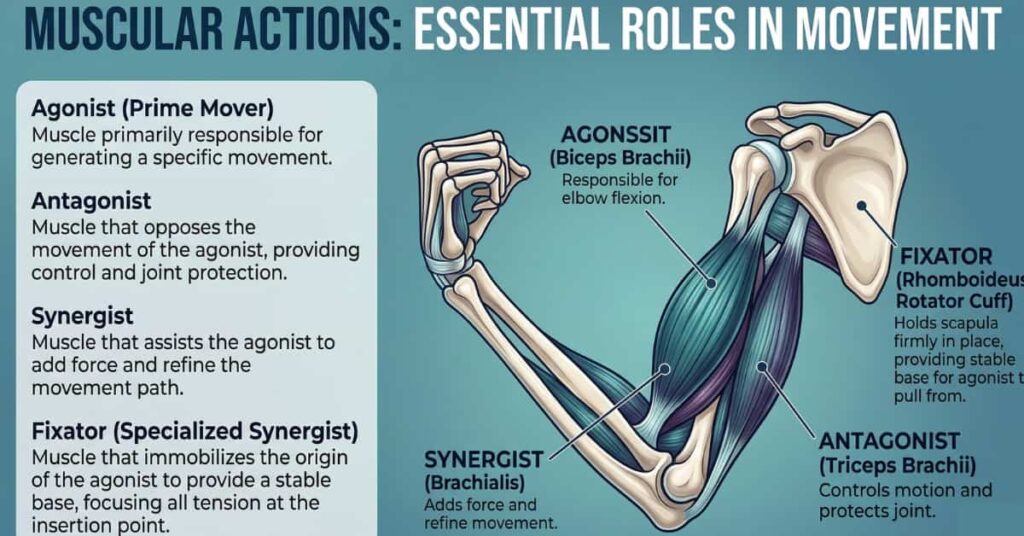
To help visualize how these four work in harmony, let’s look at a standard Bicep Curl:
| Role | Muscle Involved | Action |
| Agonist | Biceps Brachii | Contracts to lift the weight. |
| Antagonist | Triceps Brachii | Relaxes/Lengthens to allow the lift. |
| Synergist | Brachialis | Assists the biceps in elbow flexion. |
| Fixator | Rotator Cuff / Deltoid | Holds the shoulder steady. |
Why This Matters for You
Understanding these relationships isn’t just for anatomy students; it has real-world applications for health and fitness.
1. Preventing Muscle Imbalances
If you only ever train the agonists (the “mirror muscles” like chest and biceps) and ignore the antagonists (the back and triceps), you create an imbalance. It may lead to poor posture, joint pain, & an increased chance of injury because the “brake” system isn’t strong enough to handle the “engine.”
2. Improving Athletic Performance
Athletes train synergists and fixators specifically. A golfer doesn’t just need strong arms (agonists); they need incredible core fixators to stay stable during a high-speed swing. By strengthening the “support crew,” you make the “prime mover” more effective.
3. Rehabilitation and Recovery
If you have a “weak” muscle, the problem may not be the muscle itself. It might be that the antagonist is too tight (constantly “braking”) or the fixators are too weak, moving feel unstable.
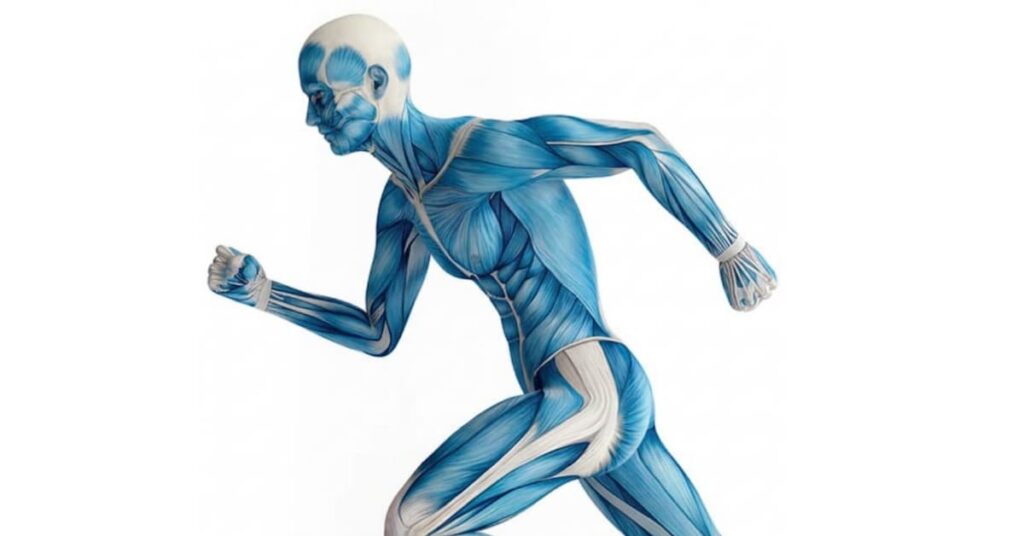
Six Practical ways to make muscle roles healthy
Here are six practical ways to ensure the agonists, antagonists, synergists, and fixators stay healthy and balanced.
1. Embrace “Oppositional” Training
The most common mistake people make is overtraining the muscles they can see in the mirror (the agonists for pushing) while ignoring the ones they can’t (the antagonists for pulling). It creates a physical “tug-of-war” that the front usually wins, pulling your shoulders forward and straining your neck.
- The Rule of Thumb: For every “push” exercise you do (like a bench press), do a “pull” exercise (like a row).
- Why it works: This ensures the Antagonist is strong enough to act as a proper brake for the Agonist, protecting the joint from wear and tear.
2. Incorporate Unilateral (Single-Limb) Exercises
When we use both arms or legs at once, our dominant side often takes over, and our Synergists on the weaker side get lazy. Unilateral training forces every muscle in that limb to show up and do its job.
- Try this: Replace a standard barbell squat with Bulgarian Split Squats, or use dumbbells for overhead presses instead of a bar.
- Why it works: Moving one limb at a time forces the Fixators (especially in the core and hips) to work much harder to keep you from tipping over, correcting imbalances before they become injuries.
3. Prioritize “Isolytics” and Eccentric Loading
We often focus only on the “up” part of a movement, the contraction. However, the health of the Antagonist depends heavily on the “down” part (the eccentric phase).
- How to do it: When performing a bicep curl or a squat, count to three on the way down.
- Why it works: Slowing the descent forces the antagonist to stay engaged and learn to control tension as it lengthens. It strengthens muscle fibers and tendons, reducing the risk of snapping during sudden movements.
4. Train on Unstable Surfaces (Occasionally)
You don’t need to join the circus, but introducing a small amount of instability can “wake up” the Fixators. If you only ever use machines that guide the movement, the stabilizer muscles eventually turn off because the machine is doing the stabilizing for them.
- The Hack: Try executing some exercises while standing on one leg, or use a cable machine instead of a fixed-path weight machine.
- Why it works: When the environment is slightly unstable, the Fixators have to fire rapidly to keep the joint centered. It builds “functional” strength that translates to real-world movements like hiking or catching yourself after a trip.
5. Don’t Skip Dynamic Warm-Ups
Jumping straight into heavy lifting or sprinting is a recipe for a “misfire” between muscle groups. If an agonist tries to contract violently while the antagonist is still “cold” and stiff, you get a muscle strain.
- The Routine: Use 5–10 minutes of dynamic stretching (leg swings, arm circles, cat-cow stretches).
- Why it works: Dynamic movement signals the nervous system to start the communication loop between these muscle roles. It “greases the groove” so the Synergists know exactly when to kick in and help.
6. Focus on Mobility, Not Just Flexibility
There is a big difference between being flexible (passive stretching) and having mobility (active control). If the Antagonist is so tight that it can’t fully lengthen, the Agonist will never be able to reach its full power potential.
- The Fix: Incorporate “active” stretching, where you use one muscle to stretch another. For example, squeeze the glutes (agonist) to help stretch the front of the hip (antagonist).
- Why it works: This teaches the brain the “Reciprocal Inhibition” principle, a neurological process in which one muscle relaxes so the other can contract. It keeps the lines of communication open and clear.
Conclusion
The body is a masterpiece of engineering. Every time you take a step, reach for a glass, or lift a heavy box, these four groups, Agonists, Antagonists, Synergists, & Fixators, are engaging in a perfectly timed dance.
By understanding that movement is a team effort, you can train smarter, move more efficiently, & appreciate the incredible coordination happening under the skin every single second. The next time you’re at the gym or out for a walk, try to “feel” which muscles are leading the charge & which ones are steadying the ship. You’ll find that the body is much more than just a collection of parts; it’s a finely tuned system.