Table of Contents
Introduction
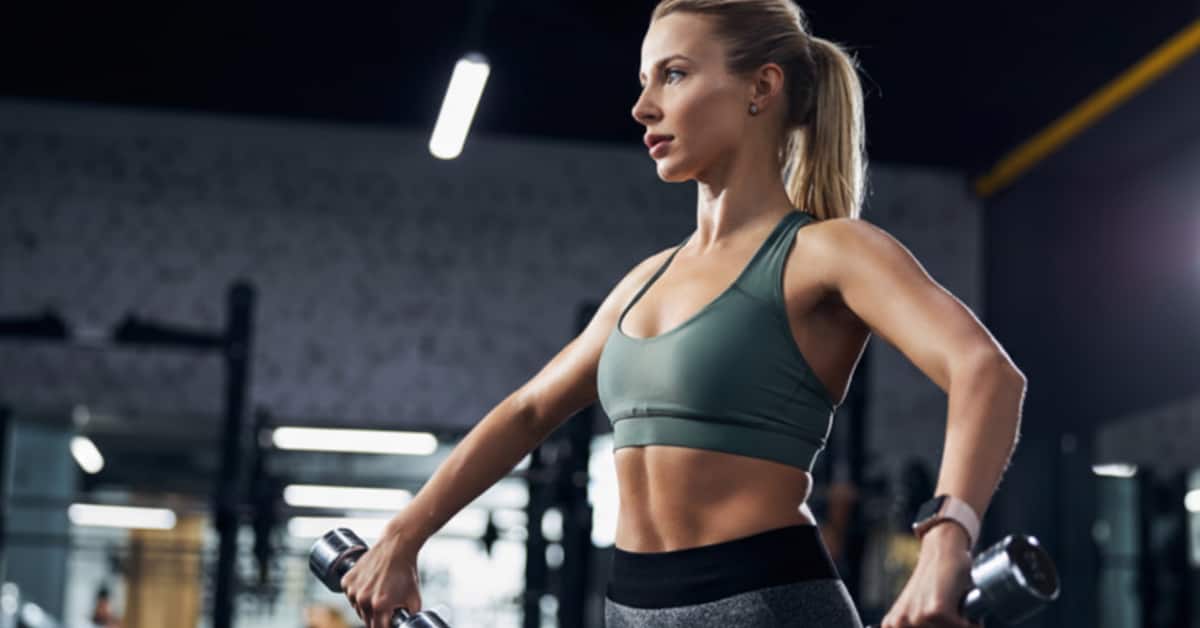
Side Lateral Raises are an isolation exercise primarily designed to strengthen and define the lateral head of the deltoid, which is the muscle on the outer side of the shoulder. By performing this movement typically lifting dumbbells outward to the sides until they reachs shoulder height you create the “width” and “rounded” appearance often associated with strong shoulders. Beyond the aesthetic benefits, lateral raises improve shoulder stability and upper-body functional strength. However, they require strict form and a controlled tempo rather than heavy weight to be most effective.

Side Lateral Raise
To maximize the effectiveness of this movement, it is essential to focus on the mind-muscle connection rather than the amount of weight being lifted. Leading with the elbows and maintaining a slight bend in the arms helps shift the tension away from the traps and onto the medial deltoids. Furthermore, maintaining a controlled “eccentric” phase slowly lowering the weights back to the sides increases time under tensions, a key driver of muscle hypertrophy and endurance.
Side Lateral Raise target muscles.
While the lateral (medial) deltoid is the primary focus of the side lateral raise, the exercise actually engages several supporting muscles to stabilize the shoulder joint and complete the lifting motion.
Primary and Secondary Muscles in Side Lateral Raises
- Primary Target: The Lateral Deltoid. It is the middle portion of the shoulder muscle responsible for the “capping” effect and shoulder width.
- Synergists (Supporting Muscles):
- Anterior Deltoid: The front part of the shoulder helps initiate the lift.
- Posterior Deltoid: The back part of the shoulder provides stability as the weight moves outward.
- Supraspinatus: 1 of the 4 rotator cuff muscles that help start the abduction of the arm.
- Trapezius (Upper and Middle): These muscles help stabilize the scapula (shoulder blade) during the movement, especially as the weights reach shoulder height.
- Serratus Anterior: Located on the ribs under the armpit, it helps rotate the shoulder blade upward.
Side Lateral Raise Form and Instructions
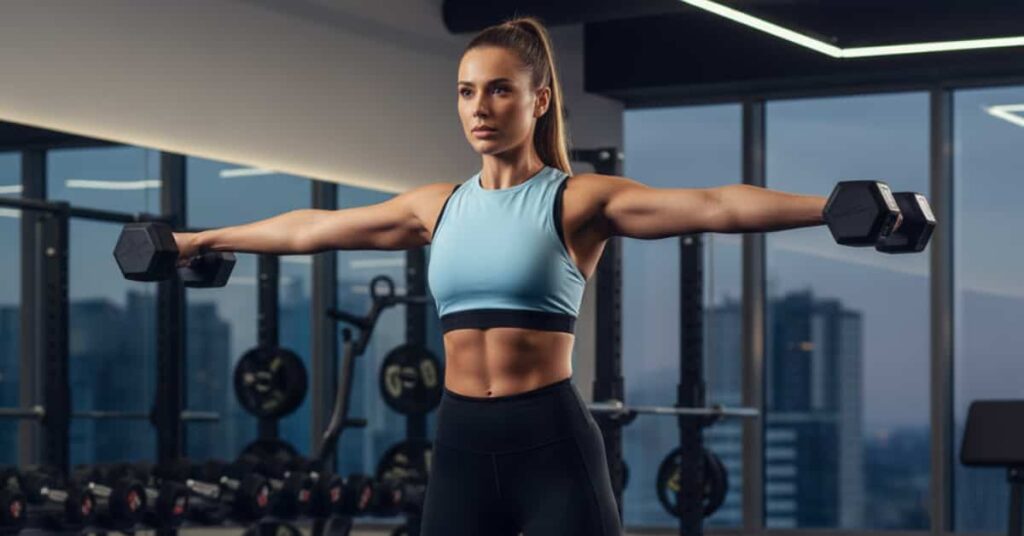
To perform side lateral raises safely & effectively, you should prioritize control & proper alignment over lifting heavy weights. Using a slow, steady tempo will ensure the deltoids do the work rather than momentum.
Step-by-Step Instructions
- The Setup: Stand with the feet hip-width apart and a slight bend in the knees. Hold a dumbbell in each hand at the sides with a neutral grip (palms facing your thighs).
- The Lean: Tilt the torso forward slightly (about 10–15 degrees). Its subtle hinge allows the lateral deltoid fibers to align with the line of gravity, reducing the risk of shoulder impingement.
- The Lift: Exhale and raise the weights out to the sides in a wide arc. Keep a slight bend in the elbows (about 20 degrees) and lead the movement with the elbows rather than your wrists.
- The Plane of Motion: Instead of lifting directly to the sides, move the arms slightly forward (about 30 degrees) into the scapular plane. It is a more natural path for the shoulder blades and improves muscle engagement.
- The Top: Stop once the arms are parallel to the floor (shoulder height). Avoid lifting the weights above your shoulders, as this shifts the tension onto the traps.
- The Descent: Inhale and lower the dumbbells back to the beginning position with a slow, controlled motion. Do not let them drop quickly; the lowering phase is just as critical for muscle growth.
Side Lateral Raise Benefits
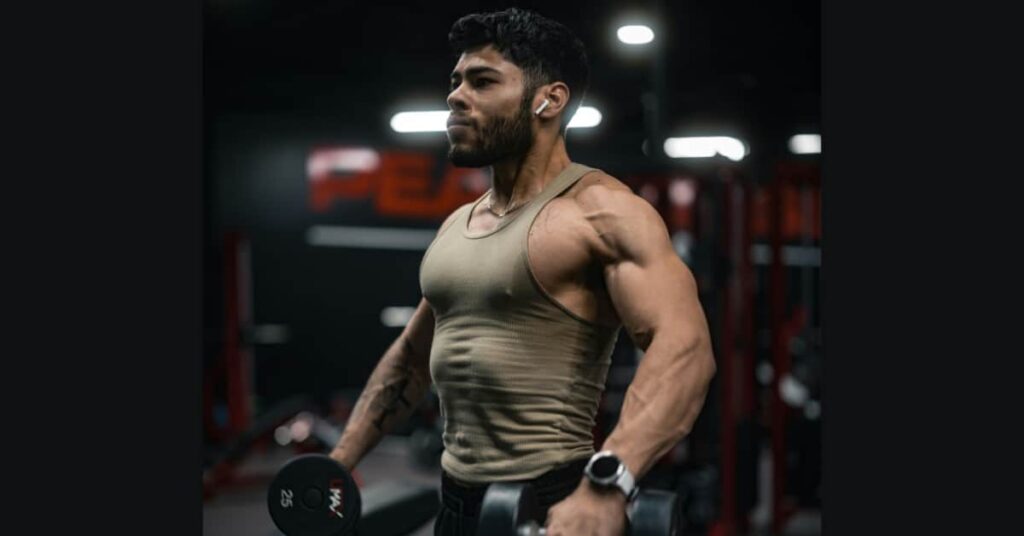
Incorporating side lateral raise into your routine offers a mix of aesthetic, functional, and health-related benefits. Because you’ve been focusing on strength training recently, understanding these advantages can help you see where this exercise fits alongside your heavier lifts, such as squats and deadlifts.
1. Aesthetic Development (The “V-Taper”)
It is the most famous benefit. By isolating the lateral deltoid, you add width to your upper body. It creates the “3D” rounded shoulder look and contributes to a V-tapered physique, which can also make your waist appear smaller by comparison.
2. Corrective & Postural Support
If you spend a lot of time sitting or studying, it’s common for those preparing for exams like the CSE, you may struggle with “hunched” shoulders. Lateral raises strengthen the middle and lower trapezius and the serratus anterior. These muscles help pull your shoulders back and stabilize your shoulder blades, directly improving your posture and reducing neck strain.
3. Joint Stability & Injury Prevention
This shoulder is the most mobile but least stable joint in the body. Lateral raises strengthen the supraspinatus (a key rotator cuff muscle), which helps keep the “ball” of your arm bone securely in the “socket.” This stability is crucial for safely performing heavier compound movements, such as the overhead press.
4. Functional Strength
Beyond the gym, this movement mimics everyday actions such as reaching for items on a high shelf, lifting bags, or stabilizing your arms while carrying a child. It builds “endurance strength” in the shoulders, making daily upper-body tasks feel significantly easier.
5. Low Impact, High Reward
Unlike heavy presses, lateral raises allow you to reach muscular fatigue with very light weights. It makes them an excellent “finisher” for your workout, stimulating muscle growth without placing excessive mechanical stress on your joints.
Side Lateral Raise Variations
To keep your shoulder training effective and prevent boredom, you can use several variations of the side lateral raise. Each version changes the “resistance curve,” meaning some make the exercise harder at the bottom, while others provide constant tension throughout.
1. Seated Lateral Raise
- The Difference: You perform the raise while sitting on a flat bench.
- The Benefit: By sitting, you remove the ability to use your legs or hips for momentum (cheating). It forces the lateral deltoids to do 100% of the work, making it one of the best variations for pure muscle isolation.
2. Cable Lateral Raise
- The Difference: Instead of dumbbells, you use a low pulley on a cable machine.
- The Benefit: Gravity only pulls dumbbells straight down, meaning there is almost no tension at the very bottom of the rep. Cables provide constant tension through the entire range of motion, that may lead to better muscle growth (hypertrophy) over time.
3. Lean-Away Lateral Raise
- The Difference: Hold onto a sturdy pole or squat rack with one hand and lean your body away at a 30-degree angle while performing a single-arm raise with the other.
- The Benefit: This angle shifts the point of maximum tension. It puts the deltoid under a significant stretch at the bottom of the movement, which is highly effective for stimulating new muscle fibers.
4. Chest-Supported (Incline) Raise
- The Difference: Lie chest-down on an incline bench (set at 45–60 degrees) and perform the raise.
- The Benefit: This is the “strictest” version. Because your chest is glued to the bench, it is physically impossible to swing your torso. It also helps you naturally move in the scapular plane (slightly in front of your body), which is safer for your rotator cuffs.
5. Resistance Band Lateral Raise
- The Difference: Stand on a long-loop resistance band and pull upward.
- The Benefit: The resistance increases as the band stretches. It makes the “top” of the movement (where the muscle is most contracted) the most challenging part. It’s also a great joint-friendly option if you are working out at home or traveling.
Comparison Table
| Variation | Equipment | Best For | Difficulty |
| Standard | Dumbbells | Overall strength | Moderate |
| Seated | Dumbbells | Preventing cheating | High |
| Cable | Cable Machine | Constant tension | High |
| Lean-Away | DB + Rack | Maximum range of motion | High |
| Chest-Supported | DB + Bench | Strict form/Safety | Moderate |
Side Lateral Raise alternative.
If you find side lateral raise uncomfortable or want to switch up the training, there are several practical alternatives ranging from heavy compound lifts to isolation movements that use different equipment, such as barbells or cables.
1. Upright Row (Dumbbell or Barbell)
It is a “pulling” movement that targets the lateral deltoids and the traps.
- How to do it: Hold the weight in front of the thighs & pull it straight up toward the chin, leading with the elbows.
- Benefit: It allows for heavier loading than standard raises.
- Safety Tip: Utilize a wider grip (shoulder-width) and stop when the elbows reach shoulder height to avoid shoulder impingement.
2. Wide Grip Overhead Press
While a standard press hits the front delts, widening the grip shifts more of the load to the side delts.
- How to do it: Use a “snatch-width” grip on a barbell. You can perform this from the front or, if you have the mobility, from behind the neck (known as a Klokov Press).
- Benefit: It builds massive functional strength and stability while contributing to shoulder width.
3. Face Pulls
Usually seen as a rear-delt exercise, face pulls are excellent for overall shoulder health and hit the lateral deltoid as a secondary mover.
- How to do it: Use a rope attachment onto a cable machine at eye level. Pull the rope towards your forehead while pulling the ends apart.
- Benefit: It improves posture and shoulder stability, which is helpful if you spend a lot of time studying or sitting.
4. Plate Raises
If you don’t have dumbbells, you can use standard weight plates.
- How to do it: Grip the edges of a weight plate and perform the raise as you would with a dumbbell.
- Benefit: The wider grip and the way the weight is distributed can feel more natural for the shoulder joint than dumbbells.
5. Landmine Lateral Raise
- How to do it: Place one end of a barbell bar in a landmine attachment (or a corner). Stand sideways to the bar, grab the end, and raise it outward.
- Benefit: The barbell’s fixed arc provides a very stable path, making it easier to focus on muscle contraction without “swinging.”
Side Lateral Raise Precautions and Common Errors
Common Errors to Avoid
- Excessive Momentum and Swinging: One of the most frequent mistakes is using the legs or lower back to “bounce” the weights up. It turns an isolation exercise into a momentum-based one, which robs the deltoids of the tension they need to grow and increases the risk of lower back strain.
- The “Pouring Water” Myth: You might hear advice to tilt the thumbs down and pinkies up at the top. It forces the shoulder into internal rotation, which can lead to shoulder impingement. It is much safer to keep the palms flat on the floor, or to have the thumbs slightly higher than the pinkies.
- Lifting Above Shoulder Height: Raising the arms too high, well above the parallel line, shifts the load from the lateral deltoids to the upper trapezius muscles. To keep the focus on shoulder width, stop the movement once the arms are level with the shoulders.
- Leading with the Wrists: If your hands are higher than your elbows, you are likely using the front delts and forearms to “curl” the weight. Focus on driving the elbows toward the walls to ensure the side delts are doing the heavy lifting.
- Shrugging the Shoulders: If you find the shoulders creeping up toward the ears, the traps are taking over. Keep the shoulder blades tucked down and stable throughout the entire set to isolate the deltoid.
Important Precautions
Focus on the Scapular Plane: Instead of raising the dumbbells perfectly out to the sides (the frontal plane), move them slightly forward at about a 30-degree angle. It is called the “scapular plane,” and it allows the shoulder joint to move more naturally, significantly reducing the risk of joint irritation.
Maintain a Slight Forward Lean: Standing perfectly upright can sometimes cause the front deltoids to take over. By leaning the torso forward just 10 to 15 degrees, you align the lateral deltoid fibers better with the line of gravity, making the exercise more effective.
Control the Eccentric Phase: Do not let the weights drop back to the sides. Lowering the weights slowly (over 2–3 seconds) is where most muscle growth occurs. It also prevents the weights from “clanking” at the bottom, which can cause you to lose tension.
Manage Your Grip Strength: Avoid gripping the dumbbells so tightly that the forearms burn more than the shoulders. A firm yet comfortable grip keeps the mind-muscle connection centered on the lateral deltoids.
Conclusion
The Side Lateral Raise is a vital isolation exercise or movement for building shoulder width & improving joint stability. By focusing on strict form and a controlled tempo rather than heavy weight, you can effectively target the lateral deltoids while minimizing the risk of injury. Mastering this move provides both aesthetic “rounded” shoulders and the functional strength needed for your daily activities and long-term fitness goals.