

Table of Contents
Introduction
Muscle contraction is the physiological procedure by which muscle fibers generate tension, acting as the primary engine for all human movement and physical stability. Far from being a simple shortening of tissue, these contractions involve a complex “sliding filament” mechanism in which proteins at the microscopic level pull against one another to produce force. Whether the muscles are visibly changing length to lift an object, stretching under control to resist gravity, or maintaining a static hold to support your posture, they are constantly navigating between two states of tension: isotonic and isometric contractions. Understanding these mechanics is vital for everyone looking to improve athletic performance, recover from injury, or understand how the body transforms chemical energy into mechanical work.
Muscle contractions are the language of human life. From the concentric power that helps us climb hills, to the eccentric control that lets us walk down them safely, and the isometric stability that holds us standing tall, every movement counts.
By comprehending how these contractions work, you can move with more intention. You’ll realize that “training” isn’t just about moving a weight from Point A to Point B; it’s about how you manage tension within the muscle during every inch of that journey.
The Basics: What is a Muscle Contraction?
Before we dive into the specific types, let’s clear up a common misunderstanding: a “contraction” doesn’t always mean the muscle is shrinking or shortening. Physiologically, a contraction means that the muscle fibers are generating tension.
Think of the muscle like a biological rubber band that has its own internal motor. Even if the rubber band isn’t moving, it can still be under a lot of “pull” or tension. That tension is what we call a contraction.
1. Isotonic Contractions: Movement in Action
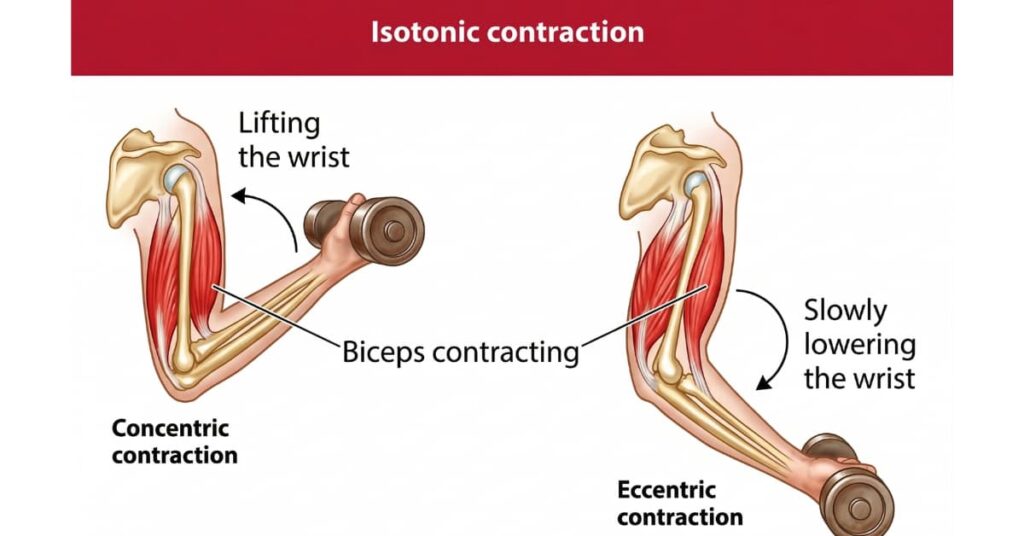
The word Isotonic comes from the Greek words “isos” (equal) and “tonos” (tension). In an isotonic muscle contraction, the tension stays relatively constant while the length of the muscle changes.
Most of the activities we do in the gym, such as squats, bicep curls, and push-ups, are isotonic. These muscle contractions are further broken down into two phases: concentric and eccentric.
A. Concentric Contractions (The “Up” Phase)
A concentric muscle contraction occurs when a muscle develops sufficient tension to overcome a load, thereby shortening. It is usually the “effort” part of an exercise in which you move against gravity.
- What’s happening internally: The tiny filaments inside the muscle fibers (actin and myosin) slide past each other, pulling the ends of the muscle closer together.
- Real-world example: When you pull a dumbbell toward your shoulder during a bicep curl, the bicep is contracting concentrically.
- Daily life example: Standing up from a chair. The quadriceps shorten to straighten the legs and lift the body weight.
B. Eccentric Contractions (The “Down” Phase)
It is the part many individuals ignore, but it’s actually where most of the strength is built. An eccentric muscle contraction happens when the muscle lengthens under tension. It occurs when the muscle resists a load rather than allowing it to fall.
- What’s happening internally: The muscle fibers are still “grabbing” onto each other to maintain tension, but they are being pulled apart by an external force (like gravity or a heavy weight).
- Real-world example: When you slowly lower the dumbbell back down after a bicep curl. The bicep is still working (if it weren’t, the weight would drop), but it is getting longer.
- Daily life example: Walking down a flight of stairs. The quads lengthen under control to stop you from collapsing into the next step.
2. Isometric Contractions: Tension Without Movement
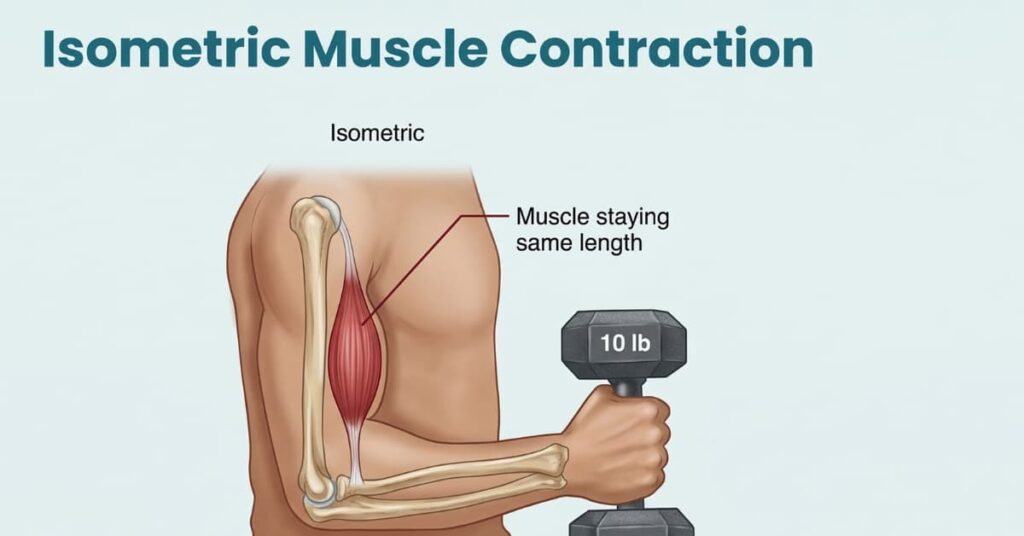
The word ” isometric ” comes from “isos” (equal) and “metron” (measure/length). In an isometric contraction, the muscle generates tension, but the length of the muscle does not change, and the joint does not move.
Visualize pushing against a brick wall. You are using a massive amount of energy, the muscles are tight, but the wall isn’t moving, and the arms aren’t shortening. That is an isometric contraction.
- What’s happening internally: The muscle fibers are firing and creating tension, but the force they are generating is exactly equal to the resistance they are facing.
- Real-world example: Holding a plank. The core muscles are screaming, but you aren’t actually “moving” anywhere.
- Daily life example: Carrying a heavy suitcase by the side. The forearm muscles are constantly in isometric contraction to keep your grip tight, even though your arm isn’t curling the bag.
Comparing the “Big Three”
To make it easier to visualize, let’s look at a simple table comparing these movements:
| Contraction Type | Muscle Length | Joint Movement | Goal |
| Concentric | Shortens | Yes | Accelerate / Lift |
| Eccentric | Lengthens | Yes | Decelerate / Control |
| Isometric | Stays the same | No | Stabilize / Hold |
Why Does the Type of Contraction Matter?
You might be wondering, “Why do I require to know this?” The truth is, the body uses these different contractions for different survival and performance reasons.
1. For Strength and Muscle Growth
If you want to get bigger and stronger, you cannot ignore the eccentric phase. Investigation shows that because you can actually handle more weight eccentrically than concentrically (about 20-30% more), the lowering phase of an exercise causes more “micro-tears” in the muscle. When these tears heal, the muscle grows back stronger.
2. For Stability and Posture
Isometric strength keeps you upright. The muscles in the back and neck are almost always under isometric tension to prevent the head from flopping forward. Without good isometric endurance, the posture collapses, leading to back and neck pain.
3. For Injury Prevention
Athletes often get injured during eccentric movements. Think of a soccer player sprinting and then suddenly trying to stop. Their hamstrings have to contract eccentrically to slow them down. If the muscle isn’t strong enough to handle that lengthening tension, it tears. This is why “eccentric training” is a staple in professional sports.
4. For Joints and Rehabilitation
Physical therapists love isometric exercises because they allow a patient to strengthen a muscle without stressing a damaged joint. If someone has a bad knee and can’t do a full squat (isotonic), they can still do a “wall sit” (isometric) to keep their quads strong without moving the knee joint itself.
Putting It All Together: A “Simple” Bicep Curl
Let’s look at how these all work in a single repetition of a bicep curl:
- The Preparation (Isometric): You grip the dumbbell. The forearm muscles contract isometrically to keep the dumbbell in the hand.
- The Lift (Concentric): You curl the dumbbell toward the shoulder. The bicep shortens, and the elbow joint moves.
- The Hold (Isometric): You pause at the top for a second. The bicep is under peak tension but isn’t changing length.
- The Lowering (Eccentric): You slowly bring the dumbbell back down to the side. The bicep lengthens under control to prevent the dumbbell from slamming into the leg.
Isokinetic Contractions: The “Advanced” Cousin
While not often mentioned in general fitness, there is a fourth type named Isokinetic. It usually requires specialized machines found in rehab centers. In an isokinetic contraction, the speed of movement stays the same, no matter how hard you push.
It is different from isotonic (where speed varies but weight is constant). Isokinetic machines ensure that the muscle is working at its maximum capacity throughout the entire range of motion, making it a gold standard for testing muscle strength during recovery.
Practical Tips for the Training
Now that you know the science, here is how to apply it to your own life or workout routine:
- Don’t Rush the Downward Phase: Most individuals drop the weights quickly. By slowing down the eccentric phase (3–4 seconds), you double the effectiveness of your workout.
- Incorporate Holds: If you find an exercise too easy, try adding a 5-second isometric hold at the “hardest” part of the movement.
- Balance is Key: A good fitness program includes movements that require you to move (Isotonic) and movements that require you to stay still (Isometric).
- Focus on Control: Whether you are lengthening or shortening the muscle, you should always be in control. If you are using momentum to “swing” a weight, you are losing the benefits of the contraction.
Conclusion
Muscle contractions are the language of human life. From the concentric power that allows us to climb hills, to the eccentric control that lets us walk down them safely, and the isometric stability that keeps us standing tall, every movement counts.
By understanding how these contractions work, you can move with more intention. You’ll realize that “training” isn’t just about moving a weight from Point A to Point B; it’s about how you manage tension within the muscle during every inch of that journey.
[…] primarily responsible for generating that specific movement. It’s the muscle that is actively contracting (shortening) to pull on the […]